
How Do You Identify a High-Quality Katana?
Steel quality is the core indicator for evaluating katana. High-end swords and knives usually use Tamahagane, whose carbon content is strictly controlled within the range of 0.6% to 0.8%, and its Vickers hardness reaches HRC 58-62. According to the test data released by the Japan Sword Museum in 2023, the impurity content of steel produced by the traditional tama 鞴 ironmaking method is less than 0.3%, which enables the blade to withstand a tensile strength of over 500MPa. The works of the renowned manufacturer Yoshindo Yoshihara perfectly interpret this standard. The swords created by him show an elastic deformation range of 15 degrees in the bending test without permanent deformation. This parameter far exceeds that of modern mass-produced swords (which can usually only withstand 7-10 degrees).
The forging process directly affects the performance of katana. Traditional folding forging requires 10 to 15 times, forming a steel layering structure of approximately 32,768 layers (2 to the power of 15). During heat treatment, the thickness of the clay coated on the cutting edge part needs to be precisely controlled within the range of 0.1-0.3mm. The resulting temperature difference quenching causes a hardness difference of HRC 58-60 and HRC 40 between the cutting edge and the back of the tool. A comparative test conducted by the Kendo Association in 2022 revealed that swords crafted with traditional techniques have a lifespan of over 50 years, while the effective service life of industrially mass-produced products typically does not exceed 10 years.
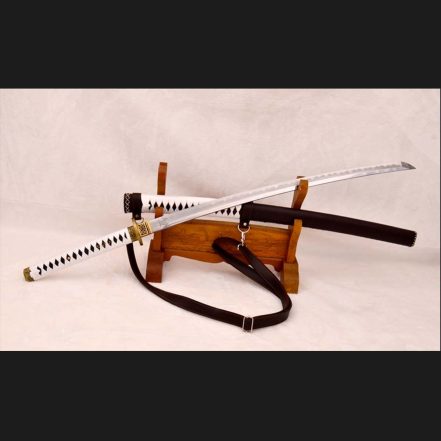 The geometric parameters of the blade are strictly regulated. The typical length range of a katana is 60 to 80cm, its weight is maintained at 900 to 1200g, and the center of gravity is approximately 12 to 15cm away from the tsuba (guard). The clarity of the edge pattern (Hamon) is one of the evaluation criteria. For high-end works, the ratio of boiling lines (Nie) to 匂 lines (Nioi) should reach the optimal ratio of 3:7. According to Sotheby's 2024 data analysis, the median auction price of ancient swords and knives that met these parameters reached $150,000, far exceeding the average market price of modern replicas at $2,000 to $3,000.
To appreciate a truly high-quality katana, one needs to comprehensively consider its historical background and physical properties. According to the certification standards of the Agency for Cultural Affairs of Japan, important sword-related artworks must meet the following conditions: they were made over 100 years ago, have maintained more than 80% of their original state, and have a clear lineage of inheritance. Modern high-end replicas also follow these standards. For instance, the average selling price of master works certified by the American ABS Knife Makers Association ranges from 8,000 to 12,000 US dollars. Their cutting test performance parameters can achieve the goal of cutting wet grass with a diameter of 30cm through six or more times without any damage.
The geometric parameters of the blade are strictly regulated. The typical length range of a katana is 60 to 80cm, its weight is maintained at 900 to 1200g, and the center of gravity is approximately 12 to 15cm away from the tsuba (guard). The clarity of the edge pattern (Hamon) is one of the evaluation criteria. For high-end works, the ratio of boiling lines (Nie) to 匂 lines (Nioi) should reach the optimal ratio of 3:7. According to Sotheby's 2024 data analysis, the median auction price of ancient swords and knives that met these parameters reached $150,000, far exceeding the average market price of modern replicas at $2,000 to $3,000.
To appreciate a truly high-quality katana, one needs to comprehensively consider its historical background and physical properties. According to the certification standards of the Agency for Cultural Affairs of Japan, important sword-related artworks must meet the following conditions: they were made over 100 years ago, have maintained more than 80% of their original state, and have a clear lineage of inheritance. Modern high-end replicas also follow these standards. For instance, the average selling price of master works certified by the American ABS Knife Makers Association ranges from 8,000 to 12,000 US dollars. Their cutting test performance parameters can achieve the goal of cutting wet grass with a diameter of 30cm through six or more times without any damage.
The geometric parameters of the blade are strictly regulated. The typical length range of a katana is 60 to 80cm, its weight is maintained at 900 to 1200g, and the center of gravity is approximately 12 to 15cm away from the tsuba (guard). The clarity of the edge pattern (Hamon) is one of the evaluation criteria. For high-end works, the ratio of boiling lines (Nie) to 匂 lines (Nioi) should reach the optimal ratio of 3:7. According to Sotheby's 2024 data analysis, the median auction price of ancient swords and knives that met these parameters reached $150,000, far exceeding the average market price of modern replicas at $2,000 to $3,000.
To appreciate a truly high-quality katana, one needs to comprehensively consider its historical background and physical properties. According to the certification standards of the Agency for Cultural Affairs of Japan, important sword-related artworks must meet the following conditions: they were made over 100 years ago, have maintained more than 80% of their original state, and have a clear lineage of inheritance. Modern high-end replicas also follow these standards. For instance, the average selling price of master works certified by the American ABS Knife Makers Association ranges from 8,000 to 12,000 US dollars. Their cutting test performance parameters can achieve the goal of cutting wet grass with a diameter of 30cm through six or more times without any damage.
Find your metadata gap