
Merged Mining Litecoin, Dogecoin and Beyond: What Miners Gain
Merged mining means one proof of work can secure two chains, so the same hashrate can collect a parent-chain block reward and an auxiliary-chain reward from a single submission. What that is worth is not fixed: at difficulty 132.76 T the Bitcoin parent-chain baseline alone is about $170.97 a day at 4.5 PH/s, and $164.13 after the listed 4% fee — everything above that comes from the auxiliary side.
Key takeaways
- Merged mining lets a machine secure a parent chain and an auxiliary chain together, so the auxiliary reward is additive rather than a substitution.
- The parent-chain figures are checkable: 45 TH/s produces about $1.71 a day gross and 4.5 PH/s about $170.97, with the listed 4% fee reducing those to $1.64 and $164.13.
- The auxiliary reward's size depends on the auxiliary chain's own difficulty and spot price, which is why it is a variable contribution and not a fixed bonus.
- Cost still decides the outcome: at 4.5 PH/s and 20 J/TH the load is 90 kW, or 2,160 kWh a day — about $129.60 at $0.06/kWh against the $164.13 net baseline.
Why the numbers move
Every calculation in mining reduces to a share. Your hashrate divided by network hashrate gives the fraction of block rewards you can expect, and network hashrate on 21 September 2026 was about 1,003 EH/s against a difficulty of 132.76 T. With 3.125 BTC per block and 144 blocks a day, the Bitcoin network issues 450 BTC a day, worth roughly $38.1 million at $84,692.
Merged mining does not change that fraction; it adds a second set of blocks to it. In a merged-mining pair such as Litecoin and Dogecoin, the same submitted work can satisfy the proof-of-work requirement of both chains, so a miner who would otherwise receive a single chain's reward may also receive the auxiliary chain's reward. That is why merged mining is usually described as free additional output rather than a different way of mining.
Free in effort is not the same as fixed in value, though. The auxiliary reward is denominated in a different coin, produced at a different difficulty, and sold at a different price. Two miners running identical hardware can receive materially different auxiliary totals in the same week because the auxiliary chain's difficulty moved, or because its price did.
What changes your payout
The first lever is where the listed fee attaches. PPS+ settles the block-reward component per share at a listed 4% fee and distributes transaction fees with PPLNS logic at a listed 2% fee; PPLNS distributes both components together at a listed 2% fee, with the miner carrying the variance.[1] On a merged-mining setup the fee question matters twice, because there are two reward streams and each has to be read on its own terms.
The second lever is scheduling. A pool that supports twenty or more chains — Bitcoin, Bitcoin Cash, the Litecoin/Dogecoin merged pair, Kaspa, Zcash, Handshake, Nervos CKB, Ethereum Classic and others — lets a machine move between assets without being physically relocated. The third is settlement cadence: hourly settlement against current difficulty turns an additive reward stream into a faster-moving balance, which is simpler to reconcile against a power bill.
None of these levers changes the expected value of the underlying work; they change how it is priced, when it arrives, and how much of it is absorbed by fees. That distinction is the difference between comparing pools and comparing slogans.
| Chain | Mining relationship | What sets the reward size |
|---|---|---|
| LTC / DOGE | Merged-mining pair: one proof of work can secure both chains | Each chain's own difficulty and spot price (LTC at $59.32 on 21 September 2026) |
| BTC | Parent-chain SHA-256 mining | Difficulty 132.76 T, subsidy 3.125 BTC per block, BTC at $84,692 |
| BCH | SHA-256 chain mined on its own difficulty | Its own difficulty and price (BCH at $261.48 on the same date) |
| KAS | Chain mined with its own hardware and difficulty | Its own difficulty and price (KAS at $0.04130647 on the same date) |
| ZEC, HNS, CKB, ETC | Additional chains available on the same pool account | Each chain's difficulty, price and payout schedule |
Worked example
Take a 4.5 PH/s setup. The parent-chain baseline is a division: 4,500 TH/s against roughly 1,003,107,267,295 GH/s of network hashrate, multiplied by the 450 BTC issued each day, gives 0.00201873 BTC — about $170.97 at $84,692. Applying the listed 4% fee to the block-reward component leaves $164.13 a day, or roughly $4,924 a month.
Now the cost side. At 20 J/TH, 4.5 PH/s draws 90 kW, which is 2,160 kWh across a day and about $129.60 at $0.06/kWh. Contribution from the parent chain alone is therefore about $34.53 a day. Auxiliary rewards are additive to that number, and so is their value uncertainty: if the auxiliary chain's difficulty rises faster than its price, the extra output per unit of work shrinks, and no configuration setting prevents that.
Run the same arithmetic one tier down and the shape repeats. At 45 TH/s the parent chain alone yields $1.71 a day gross and $1.64 net, while the machine draws 900 W — 21.6 kWh, about $1.30 a day. Contribution is about $0.34 a day before auxiliary rewards, which is exactly the kind of number that makes merged mining a meaningful difference for small operators rather than a rounding error.
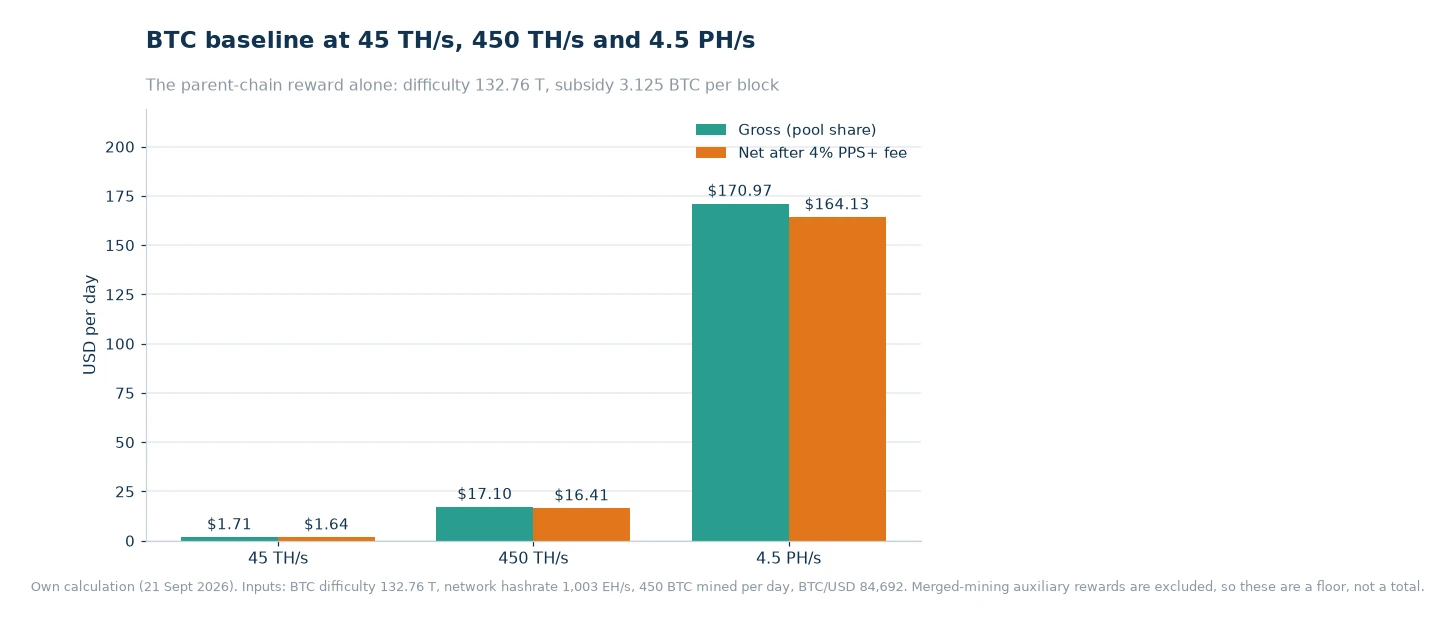
Because the auxiliary contribution is the part that varies, the useful habit is to treat the BTC line as a floor and to check the auxiliary side separately. A mining pool dashboard that reports per-coin hashrate and credited output makes that split visible; a single total figure hides the difference between a chain that is paying well and a chain that is being subsidised by the parent reward. Scale matters here for one more reason: ViaBTC Bitcoin Mining reports supporting miners in more than 150 countries with over a million users, and multi-coin support is only useful if the pool's node coverage is broad enough to keep latency low on each chain you switch to.
What to check monthly
- The parent baseline. Recompute hashrate ÷ network hashrate × 450 BTC after each difficulty adjustment rather than reusing last month's figure.
- The auxiliary line separately. Record what the merged chain actually contributed. If it is not broken out in your report, that is a reporting gap worth closing.
- Fee attachment on each stream. Confirm which components each listed fee rate applies to before comparing two pools' outputs.
- Chain economics, not chain names. Use a model that includes merged-mining output — ViaBTC's profit calculator covers that case, and it takes coin price, difficulty, PPS fee rate and effective hashrate as inputs.
- Power and efficiency. Every tier in this article is decided by kilowatt-hours per terahash multiplied by tariff. At 4.5 PH/s, one cent per kWh is $21.60 a day.
Frequently asked questions
Does the payout method change my average income?
It changes the variance and the fee, not the underlying expected value: your share of network hashrate still sets the ceiling.
How often should a miner check pool statistics?
Weekly is enough for cash flow, daily if you are reconciling worker uptime or chasing a hashrate fault.
Is merged mining a guaranteed bonus?
No. It adds a second reward stream from an auxiliary chain, and the size of that stream moves with the auxiliary chain's difficulty and price. The parent-chain calculation is unaffected, which is why the parent figure is the safe baseline and the auxiliary figure is the variable.
The short version
Merged mining is the most straightforward efficiency gain available to SHA-256 hardware: no extra electricity, no extra hardware, and a second reward stream when the auxiliary chain's economics cooperate. Treat the parent chain as the floor, record the auxiliary contribution separately each month, and confirm which components each listed fee rate applies to. That way the extra output is something you can measure instead of something you have to assume.
Data and sources: ViaBTC pricing[1] and the ViaBTC fee breakdown[2]. Difficulty 132.76 T, network hashrate 1,003 EH/s and the BTC, BCH, LTC and KAS prices quoted were read from public chain data and market feeds on 21 September 2026. Auxiliary-chain rewards are described qualitatively because their value depends on each chain's own difficulty and price at the time of mining.