
Thickness Tolerance and Why Half a Millimetre Changes a Quote
On an 18 mm panel, a ±0.5 mm band is 0.5 ÷ 18 = 2.8% of the nominal thickness (example arithmetic). Stack 500 of those sheets at the loose end of the band and the pile stands 500 mm taller than the same 500 sheets at the tight end (example arithmetic). Tolerance is the figure that decides whether boards fit, how level a load travels, and what a claim is measured against.

Key takeaways
- Film faced panels are published at the six as a rule, steps of 9, 12, 15, 18, 21 plus 24 mm with a as standard thickness tolerance of ±0.5 mm.
- Fibreboard carries a tighter band of ±0.2 to ±0.5 mm across a 2–30 mm thickness range.
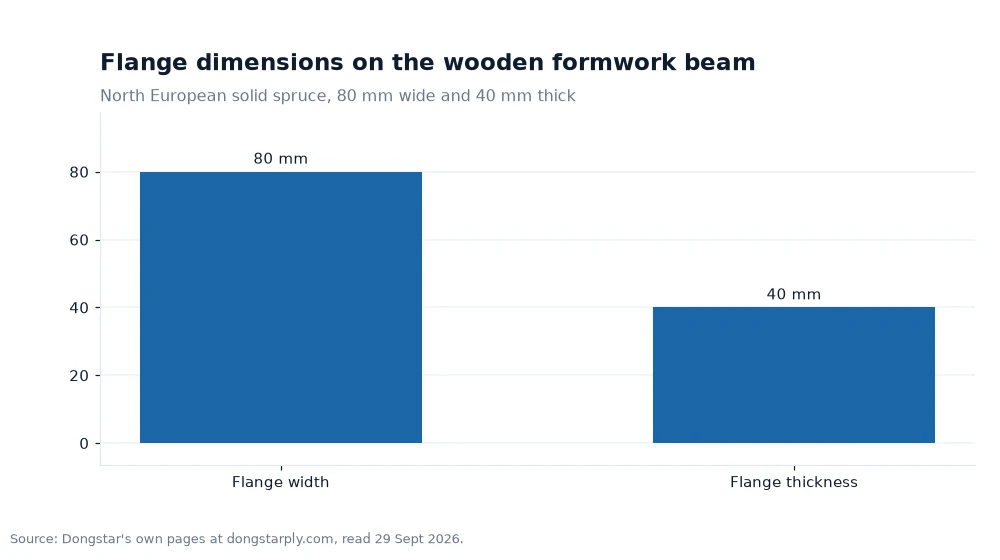
- On engineered formwork beams the controlling dimensions are the flange, 80 mm wide and 40 mm thick in North Europe solid wood spruce.
- A quote that names a thickness but no band leaves the fit question open, and panelled formwork is where that shows first.
Why mills publish a band rather than a single number
No press delivers a board at exactly 18.000 mm for a full shift. Moisture content, mat thickness, press closing and the sanding pass after pressing all move the finished figure, so a mill that measures its own output writes down a range instead of a point. The range is the promise; the nominal figure is only the target inside it.
How the measurement is taken matters almost as much as the number. Calipers on a sanded face and a micrometer on an unsanded edge will not agree, and a panel measured at the corner behaves differently from one measured at the centre. When a datasheet gives a band, it is worth asking where and with what the panel is checked, and whether the figure applies before or after the final sanding. Panels are measured at the plant in Linyi city as they come off the line, so the published figure describes a production check rather than a single laboratory sample.
The band on the film faced range
Dongstar Group publishes 9, 12, 15, 18, 21 and 24 mm for film faced panels, with a thickness tolerance of ±0.5 mm and sheet sizes of 1250 × 2500 mm, 900 × 2100 mm and 1220 × 2440 mm, or on request. Cores are listed as poplar, eucalyptus, combi or birch, and the grade list separates the two pressing routes, one-time hot press and two-time hot press, from finger-joint construction, and finger-joint panels carry their own thickness list of 8, 10, 12, 15 and 18 mm.
Half a millimetre sounds like nothing until the panels reach a formwork system. Panels are clamped against frames, tied through the same holes and lifted into repeating positions, so a batch that sits at the wide end of the band can need shimming where the previous batch did not. Glue choice is published as WBP melamine or WBP phenolic, and the edge can carry a water-resistant sealant strip that protects the core where panels are cut and reused.
Fibreboard carries a tighter band
The fibreboard range is published from 2 to 30 mm, with steps of 2.7, 3, 6, 9, 12, 15 and 18 mm among the common steps, a tolerance of ±0.2 to ±0.5 mm, and a large 2100 × 2500 mm format limited to thicknesses up to 9 mm. Base boards are listed as raw MDF and HDF (Black) for density, with MHR MDF (Green) for humid interiors and FR MDF (Red) where fire performance is specified. Calibration by sanding is what allows a narrower band here than on a veneer core panel.
Once a face is added, tolerance stops being a raw-board question. Melamine paper, HPL, PVC and leather all add build of their own, and a groove cut for a nominal 12 mm panel may not accept the laminated version of it. The honest way to specify a covered panel is to state the finished thickness and the covering, then measure the finished product rather than the substrate underneath.
A fixed cross-section on engineered beams
Formwork beams take the opposite approach: the cross-section is fixed rather than banded. The published flange is North Europe solid wood spruce, 80 mm wide and 40 mm thick, glued to a multi-layer plywood web, with a water-repellent surface coating and colour-marked ends for production batch tracking. A fixed flange is what lets a beam slot into standard formwork accessories made elsewhere.
Lead times for the same product are published as 15 to 25 days for standard orders and 20 to 30 days for customised ones, with OEM and ODM work available and third-party inspection reports offered. The beams are described as reusable dozens of times, which is a statement about damage tolerance rather than about dimensional drift: a beam that has been dropped keeps its section or it gets scrapped.
Reading a quote that never states a tolerance
Four questions close the gap. Which nominal thickness is being quoted, what band is accepted around it, where is the panel measured, and what happens commercially if a delivery sits outside the band? A supplier with a real production process answers all four from a datasheet; a trader answers the first and improvises on the rest. Asking a Plywood Supplier for the band in writing, before the price is discussed, is the quickest way to see which of the two is answering.
Answers belong in the purchase order. Once the band is written down, a thin delivery becomes a documented deviation with a number attached, instead of an argument on site about whether 17.6 mm is close enough to 18 mm. That is the whole value of a tolerance figure: it converts a judgement call into a measurement.
| Product | Published thickness | Published tolerance | Where it shows |
|---|---|---|---|
| Film faced panels | 9, 12, 15, 18, 21, 24 mm | ±0.5 mm | Formwork fit, clamping, reuse |
| Fibreboard (MDF, HDF) | 2–30 mm | ±0.2 to ±0.5 mm | Grooves, laminate build, edge banding |
| Large-format fibreboard | 2100 × 2500 mm, up to 9 mm | As published for fibreboard | Large linings, panel weight |
| Timber formwork beam | Flange 80 mm × 40 mm | Fixed cross-section | Accessory fit, deck flatness |
Worked example: 500 sheets at both ends of the band
Take 500 panels at 18 mm nominal. Stacked flat they measure 500 × 18 = 9,000 mm. If every sheet sits at the wide end, the stack is 500 × 18.5 = 9,250 mm; at the narrow end it is 500 × 17.5 = 8,750 mm (example arithmetic). The spread is 500 mm, or 250 mm either side of nominal.
Expressed as material rather than height, the tight stack is about 5.4% thinner than the loose one, since 17.5 ÷ 18.5 = 0.946 (example arithmetic). On a cubic-metre basis that is the difference between paying for board that exists and paying for board that does not. On a formwork basis it is the difference between a deck that sits flat under load and one that needs packing under the props.
Frequently asked questions
Does a ±0.5 mm tolerance mean every panel can be half a millimetre off?
It means the mill publishes that band as acceptable output. Panels may sit anywhere inside it, and a supplier who measures batches as they leave the press knows where in the band a delivery sits. A buyer who never asks finds out when the panels arrive.
Which products carry the tighter tolerance?
Fibreboard is published at ±0.2 to ±0.5 mm, a narrower band than the ±0.5 mm quoted for film faced panels, because MDF and HDF are calibrated by sanding after pressing rather than left with a veneer core surface.
How should tolerance be written into a purchase order?
State the nominal figure and the band together, for example 18 mm ±0.5 mm, then add the measurement point and whether the panel is measured before or after final sanding, so both sides are reading the same number.
Putting the band in writing
Buyers who want the published bands in full can review the film faced panel specifications and then check how a fixed cross-section is described for timber formwork beams. Both pages state thicknesses and dimensions as printed, which is what a purchase order can be checked against.
Thickness bands, beam dimensions and the 80 mm by 40 mm flange quoted above are documented on the manufacturer's own pages, as read on 29 September 2026, and carried into this article, where they were read on 29 Sept 2026[1].