
How to Evaluate a Fragrance Factory for an EU Launch
Evaluating a fragrance factory for an EU launch is a scoring exercise, not an exchange of opinions: you collect evidence against a fixed set of criteria, weight them for your product, and decide before the third meeting instead of after the third crisis. Compliance capability, GMP discipline, perfumery depth, testing infrastructure, communication, references and cost transparency are the seven criteria that predict how an EU project will go. Read the evidence, not the brochure.
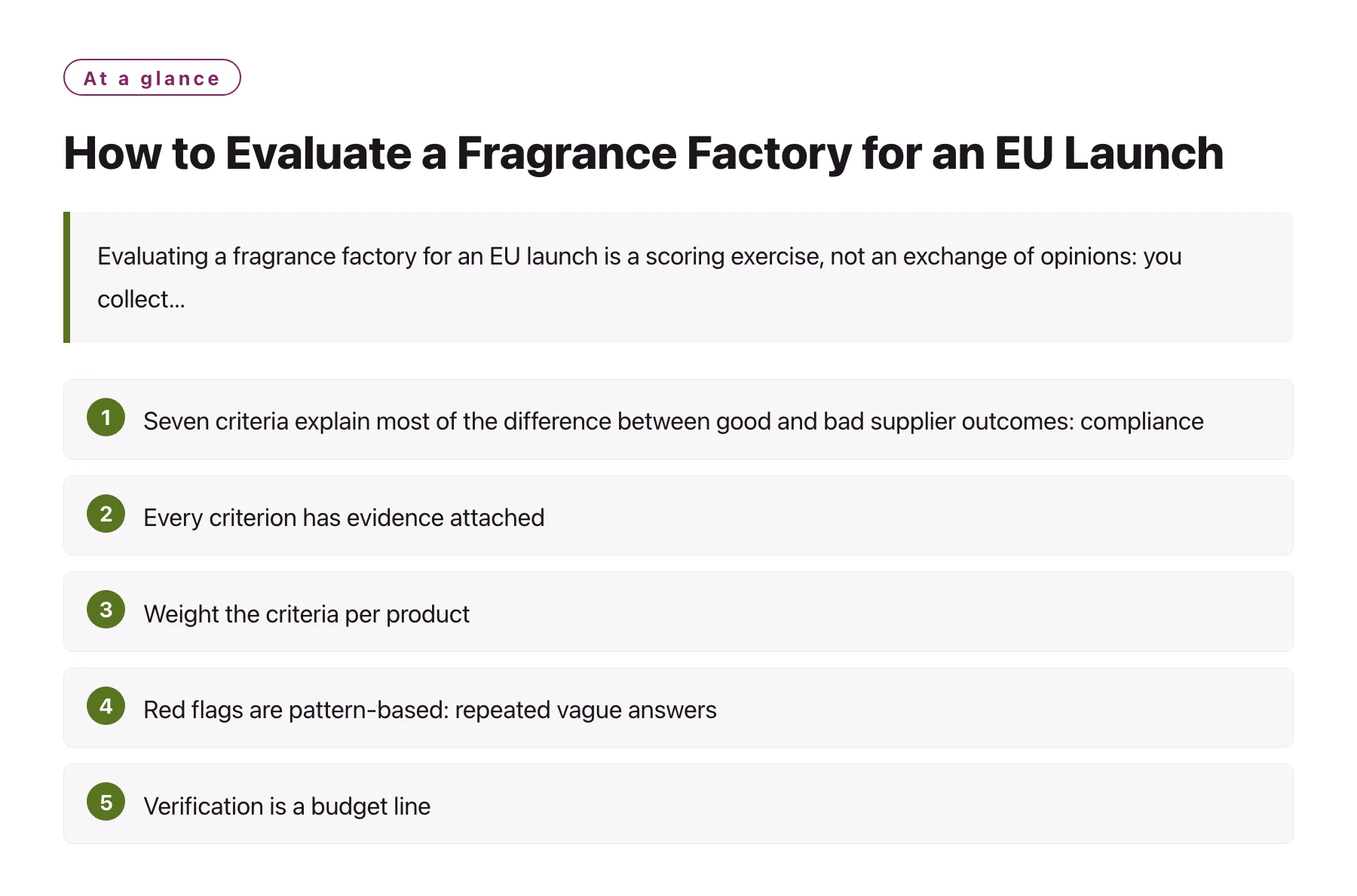
Key takeaways
- Seven criteria explain most of the difference between good and bad supplier outcomes: compliance, GMP, perfumery depth, testing, communication, references and cost transparency.
- Every criterion has evidence attached, a certificate number, a batch record, a reference call, a line-item quote, and evidence is what you score.
- Weight the criteria per product, because a niche launch and a large retail programme do not need the same factory.
- Red flags are pattern-based: repeated vague answers, missing document dates and ownership nobody can name end an evaluation early.
- Verification is a budget line, not an insult: certificate numbers, batch samples and reference calls take hours, not months.
There are two ways to choose a factory: by impression, or by evidence. Impression works until the first batch, and by then the evaluation was the cheapest part of the project.
The framework below is the one used in sourcing reviews: criteria, evidence, weighting, and the discipline to write the scores down.
The evaluation scorecard
| Criterion | Evidence to collect | Why it carries weight |
|---|---|---|
| EU compliance capability | Document pack from a recent EU-bound product, blanked if needed | Market entry depends on it; it is the least negotiable row |
| GMP discipline | ISO 22716 or equivalent certificate with a scope line; one batch record | Shows the process can be repeated and audited |
| Perfumery depth | Development team, in-house library, brief-to-sample time | Decides how well your brief becomes a smell |
| Testing infrastructure | Stability, microbial and fill checks in house or via a named lab | Controls timeline risk on every batch |
| Communication | Response time and willingness to answer in writing | Predicts the working relationship across months |
| References | Other EU buyers who will take a call | The fastest way to validate claims |
| Cost transparency | Line-item quote, defined revision counting, named assumptions | Prevents the single surprise invoice |
Score each row on the evidence you actually collected, not the evidence you hoped for. A row with no evidence scores nothing.
Reading the evidence, not the brochure
Certificates: read the number, not the logo
Collect certificate numbers, issuing bodies and scope lines, then verify at the source. Testing and certification companies describe their audit scopes openly, which tells you what a certificate of a given type actually covers [1]. A certificate without a number is decoration.
Batch records beat brochures
Ask for a real batch record, raw material intake, compounding, filling, release, and read it as a story. The story should have signatures, dates and no unexplained gaps; the record is the audit trail, and it is what a certification auditor would ask to see first.
The compliance file
Your product's EU file, safety assessment, product information file and notification, is assembled from supplier inputs, so the evaluation has to confirm those inputs exist in the right form. The European Commission's cosmetics pages define the file obligations [2], and the interview question is whether the factory has produced these inputs for someone already.
Fragrance safety is the deep end of that file. IFRA publishes the science behind the safe use of fragrance ingredients, which is a useful reference for understanding what 'screened' actually means before you accept a statement on trust [3].
The site visit
Walk the compounding and filling areas and look for three things: order, labelled materials and accessible records. The brochure promised the first two; the plant shows whether the promise is a habit.
Applying the framework
Build a weight per product. If you are launching two products into two EU markets, compliance and testing weigh heavy. If you are scaling a proven formula, perfumery depth weighs less and production predictability weighs more. The same scorecard, different weights, different answer.
When you screen candidates, calibration is easier with a manufacturer that publishes its operations; its official website is the obvious first place to check service scope, certifications and categories before you schedule a call.
References belong on the list: ask for two or three buyers you can call, and ask them product-level questions about document quality, sample speed and deviation handling. examples of fragrance projects should exist in some honest form if the factory does this for a living; what matters is that the examples are verifiable, not glossy.
Finally, geography matters less than documentation. a Chinese factory for perfume brands with a documented, EU-exporting habit is easier to audit than a local factory with no file discipline, because the audit is about the file, not the airport.
Write the scores before the third meeting. An evaluation is only as good as the paper trail it leaves behind: the same discipline you are asking the factory to demonstrate is the discipline you should demonstrate in choosing it.
Sources
- SGS: Cosmetics, Personal Care & Household Testing —— Testing, inspection and certification services for cosmetics and personal care, including microbiological, stability and safety testing aligned with cosmetics GMP.
- European Commission: Cosmetic Products — Specific Topics —— EU pages covering specific cosmetics topics such as product claims, nanomaterials and animal-testing rules.
- IFRA: Safe Use and Fragrance Science —— IFRA's explanation of how fragrance materials are scientifically assessed for safe use and how those conclusions are applied by the industry.
Frequently asked questions
How many factories should I evaluate?
Three is a workable number: enough to see how the market answers the same brief, few enough to keep the comparison honest. Send the same brief to all three and score the same criteria.
What weight should compliance carry?
For an EU launch, weight compliance and testing highest, usually forty to fifty percent combined for the regulated rows. The rest splits across perfumery depth, communication and cost.
Should I pay for a third-party audit?
For a large first order, yes, the cost is small against the batch risk. For an exploratory comparison, the desk review and your own visit are usually enough.
How do I check a certificate number?
Contact the issuing body with the number and the scope. Certification bodies maintain registers and are used to this question; a factory that cannot give you a number has answered for you.
Which red flags end an evaluation immediately?
A missing certificate number, a batch record with gaps nobody can explain, an absent packaging-compliance owner, and references that never materialise. Any one of these is a pattern.
Find your metadata gap